


Saudi Arabia’s Crown Prince Mohammed bin Salman has officially launched the Saudi Architecture Characters Map, a project featuring 19 architectural styles that reflect the Kingdom’s diverse landscapes and cultural heritage. The initiative aims to modernize urban spaces while preserving architectural traditions that have shaped Saudi cities for centuries.
The map showcases styles drawn from Saudi Arabia’s varied geography, spanning the Central and Northern Najdi designs influenced by the country’s desert heartland to the Hejazi Coast style, which carries echoes of centuries-old trade routes. The lush, date-palm-filled oases of Al-Ahsa and Al-Qatif have inspired designs rooted in the region’s agricultural traditions, while the Sarawat Mountains and Abha Highlands contribute architectural elements adapted to rugged, high-altitude environments. Along the coastline, influences from Tabuk to the Farasan Islands shape designs that merge practicality with a distinct maritime aesthetic.
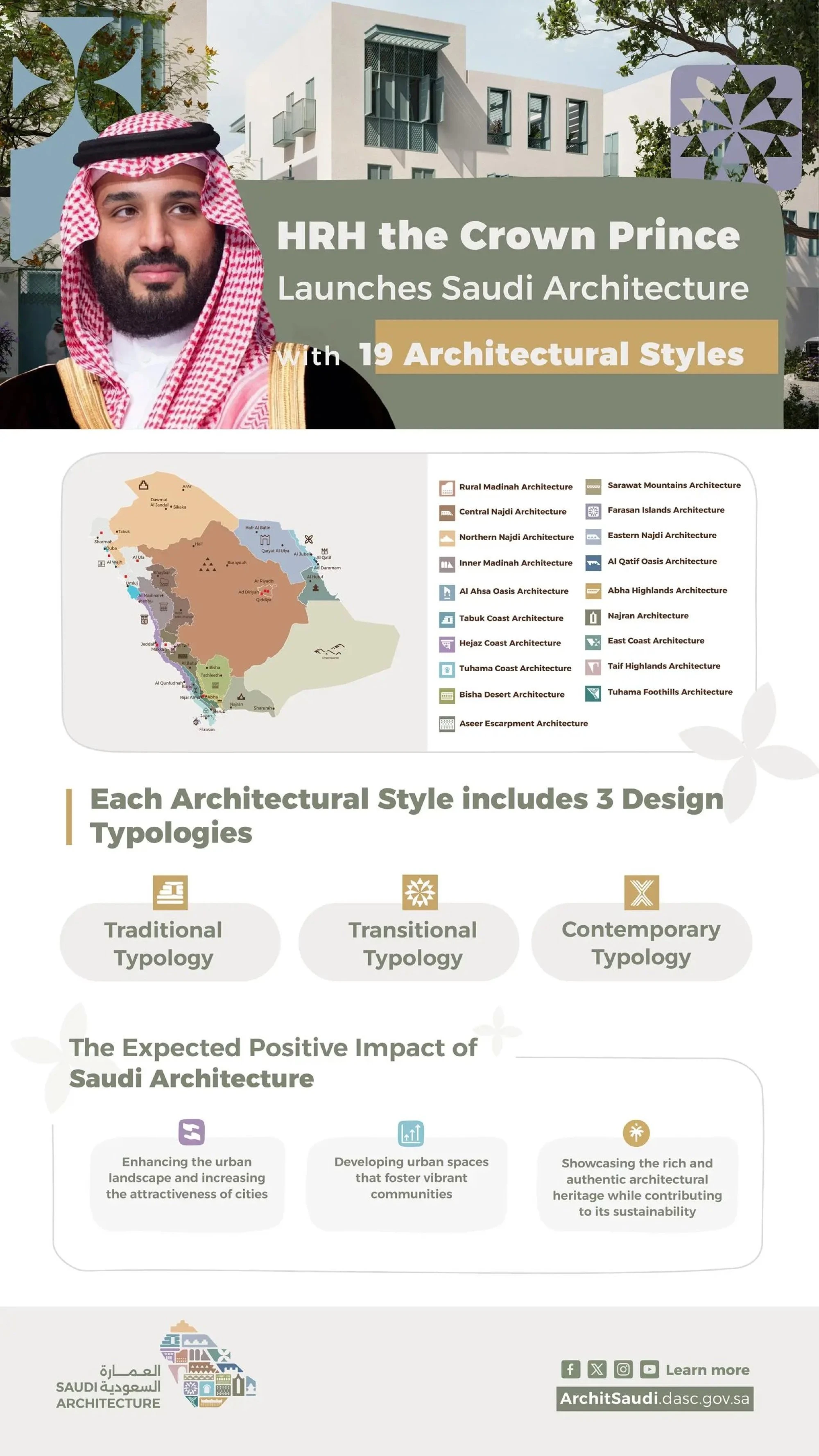
Speaking as Chairman of the Supreme Committee for Saudi Architectural Design Guidelines, the Crown Prince highlighted the project’s role in shaping a future where urban spaces remain deeply connected to their surroundings. “Saudi architecture blends our rich heritage with contemporary design thinking. We are enhancing urban landscapes and quality of life as well as building an architectural framework that balances the past and the present. This model will serve as a global source of inspiration for innovation in architectural design,” he said.
The Saudi Architecture Characters Map is designed with flexibility, offering developers three typographies—traditional, transitional, and contemporary—within each style. The initiative seeks to empower local talent while ensuring modern materials can be used without placing excessive financial burdens on builders.
Its phased rollout will begin in key locations, including Al-Ahsa, Taif, Makkah, and Abha, where initial applications will shape major projects, government buildings, and commercial developments. Beyond aesthetics, the map is positioned to be an economic driver, with projections estimating an SAR8 billion contribution to GDP by 2030 and the creation of over 34,000 jobs across engineering, construction, and urban development.