



Lost Treasures of Arabia: The Nabataean Kingdom doesn’t just retell history; it gives new life to one of the world’s most intriguing ancient civilisations. Narrated by Maggie Gyllenhaal, this National Geographic film shines overdue recognition on the Nabataeans, a people who, as she says in her opening line, “turned stones into cities and sand into thriving trade routes”.

The documentary, produced in collaboration with the Royal Commission for AlUla (RCU), revisits the remarkable story of the Nabataeans, whose ingenuity and strategic skill once shaped Arabia’s desert crossroads. At its heart is archaeologist Dr Laïla Nehmé, who has spent decades excavating Hegra, the Nabataeans’ southern capital and Saudi Arabia’s first UNESCO World Heritage Site.
“I’ve been working on Hegra for over 20 years,” says the Lebanese French specialist in the archaeology and epigraphy of the Ancient Near East. “When I first took part in a documentary in 2003, we had barely begun excavations. The results were modest then, but what we’ve achieved now is extraordinary.” The documentary, she adds, arrived at exactly the right moment to showcase the latest discoveries. “It captures the enthusiasm that drives us and presents the Nabataeans as figures the public is eager to discover.”
Rediscovering a Lost Kingdom

The ancient Arab people, whose influence once stretched from the Red Sea to Damascus, were brilliant engineers, traders, and diplomats. Yet for centuries they remained in the shadows of better-known empires. “The global audience often doesn’t even know who the Nabataeans were,” admits Nehmé. “The challenge is to make their story accessible and attractive. This documentary achieves that, with clear narration and re-enactments that bring history closer to viewers.”
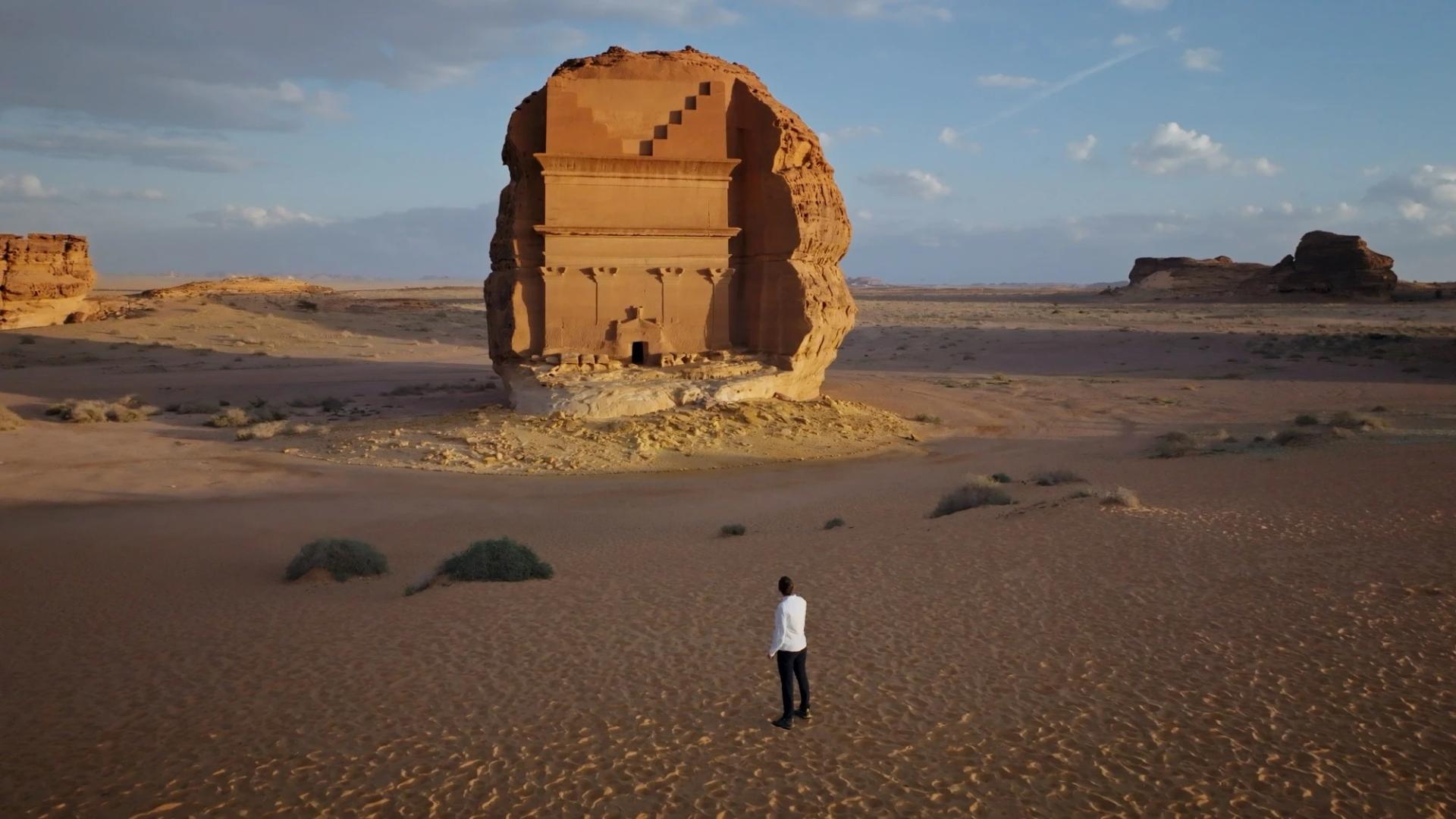
At Hegra, their genius is written directly into the sandstone. Towering rock-cut tombs, carved with astonishing precision, rise from the desert as if sculpted by gods. “They had no room for error,” says Nehmé. “One extra strike of a chisel could ruin everything. Yet they created new architectural styles by blending Mesopotamian, Greek, and Egyptian influences into something instantly recognisable as Nabataean.”
The author of Guide to Hegra: Archaeology in the Land of the Nabataeans of Arabia’s fascination is as much about their skill as their humanity. She recalls one unforgettable discovery: a necklace made of fresh dates, found still resting around a skeleton’s neck. “It’s such a touching detail,” she says. “The dates were meant to be eaten in the afterlife. It shows how the Nabataeans cared for their dead and believed in continuity beyond life.”
Lessons from the Desert


That human connection extends to their relationship with nature. “They were extraordinary navigators,” explains Nehmé. “They could cross vast desert distances using natural landmarks and the stars. And their understanding of water management was remarkable.” At Hegra, they built wells that reached deep aquifers and cisterns that collected and filtered rainwater. “Their techniques can still teach us about sustainability today. Modern architects have even asked how they might apply those methods to limit pressure on water resources in the region.”
Hegra is often described as Petra’s smaller sister, but Nehmé insists its role was vital. “It lies at the southern edge of the Nabataean kingdom, opening onto the vast expanses of Arabia,” she says. “Its location makes us ask who founded it and why. It may be linked to the development of seafaring on the Red Sea and the Nabataeans’ wish to control the incense trade as it shifted from land to sea.”
You Might Also Like: Watch the new National Geographic documentary shedding light on the Nabataean Kingdom
History, Mystery & Now


The documentary explores such turning points with cinematic flair, from Cleopatra’s entanglement with Nabataean politics to the dramatic tale of a Nabataean guide who led the Roman army astray in the desert. The result is less a history lesson and more a rediscovery, positioning the people who initially started as nomadic desert dwellers as thinkers and innovators rather than simply traders and builders.
For Nehmé, the satisfaction comes not from spectacle but from understanding. “Archaeology and epigraphy can be painstaking, but the reward is in the discoveries,” says the expert who was elected a 2023 corresponding fellow at the British Academy. “A single fragment of textile can reveal trade connections stretching from Arabia to India and China. Each finding adds another piece to the puzzle.”
She speaks, too, of the quiet beauty that keeps her returning to AlUla year after year. “The light at Hegra in the late afternoon is extraordinary. The sun dips, the sandstone turns orange, and the desert glows. Driving back to the dig house with music playing, those are the moments when time feels suspended.”
A Life Amongst Revelations

Off the site, her pleasures are simple. “Archaeologists are always hungry and rarely rich,” she laughs. “My favourite place in AlUla is a small Syrian restaurant called Arwad, in the city centre. It serves grilled meats, hummus, and salads, and it’s always full. Just thinking about it makes my mouth water.”
For first-time visitors to Hegra, she recommends venturing beyond the famous Qasr al-Farid. “Everyone photographs it, but there’s another tomb, IGN 100, almost as large and directly opposite it. It’s a beautiful example of Nabataean architecture, with female sphinxes, Doric friezes, and elegant proportions. It deserves much more attention.”
Now streaming globally on Disney+, Lost Treasures of Arabia: The Nabataean Kingdom offers a window into a world that still has secrets to share. “The Nabataeans didn’t build empires with swords,” says RCU’s chief tourism officer, Phillip Jones, in the film. “They built them with aqueducts, incense, and strategic alliances.”
Nehmé’s work proves that their story is far from over. Each excavation, each discovery, adds another chapter to the long history of a people who learned to turn the desert itself into their greatest creation.