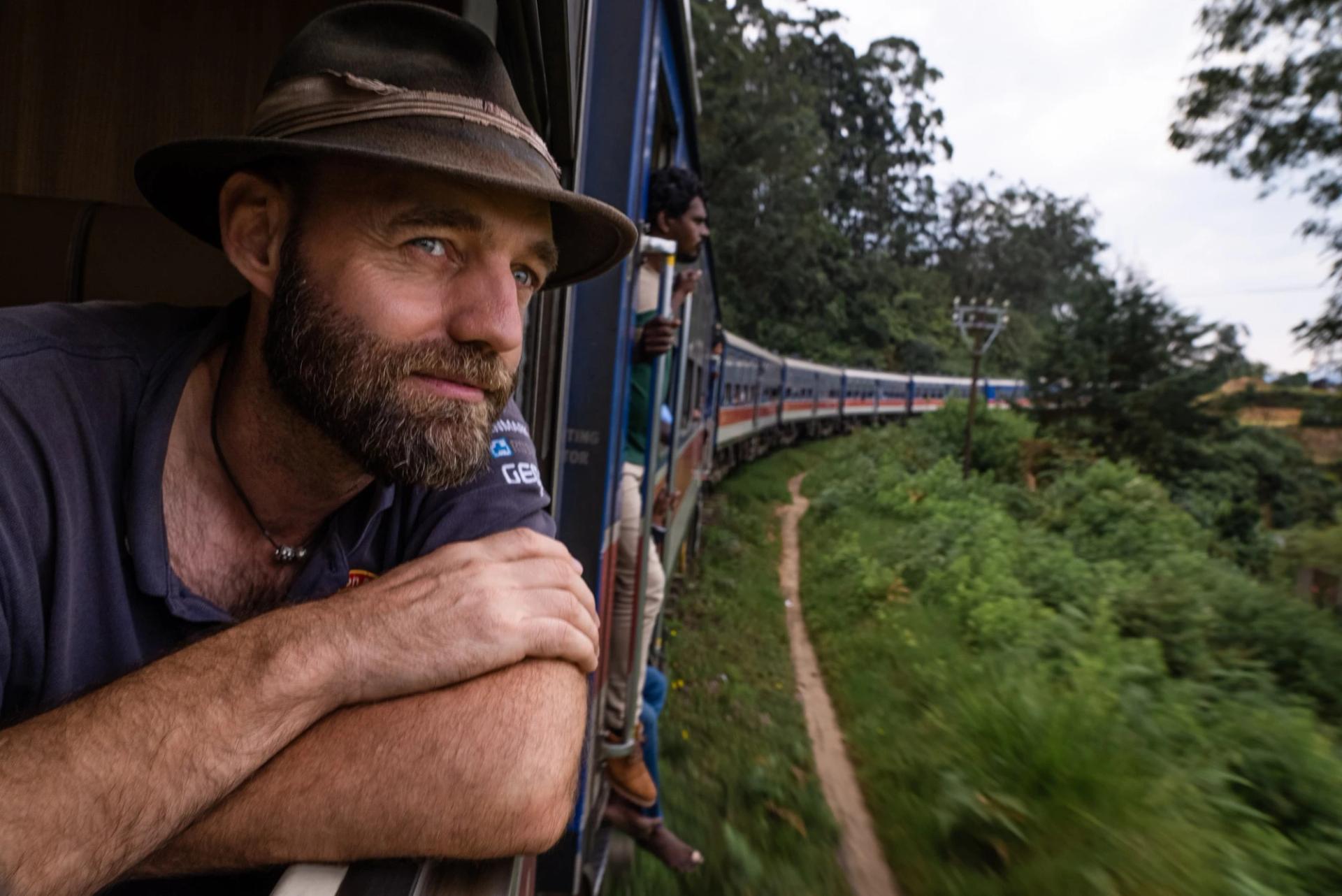





Setting out a decade ago with just three simple rules — no flying, no returning home, and a US$20 daily budget — Thor Pedersen embarked on a quest to reach every country in the world.
In 2013, at the age of 34, Thor challenged himself to follow these three self-imposed rules and spend at least 24 hours in each country.


Subsisting on US$20 a day, this modern-day Ibn Battuta originally anticipated it would take four years to reach all 203 countries without setting foot on an aircraft. But when it comes to travel, little is predictable and with such a challenge ahead, something is bound to go awry. For Thor, several visa delays, more than 11,200 kilometre-long detours, travel restrictions, adverse weather conditions, a bout of cerebral malaria, not to mention a global pandemic in the middle of it all, meant a whole decade on the road.
That’s 3,567 days of adventures, aggravations and anecdotes – all recounted in the Danish adventurer’s new memoir, ‘The Impossible Journey.’ Ahead of his appearance at the Emirates Airline Festival of Literature, which is slated to take place in Dubai from January 21 to 27, 2026.
I recently sat down with Thor Pedersen to explore his entirely unique world view, a conversation I am now excited to share with the LIST audience.
First of all, the obvious starting point: why did you challenge yourself to travel around the world without flying?

When I was a child, my mother would take me with her in the forest when she was looking for mushrooms. She would tell me stories about true and imaginary adventures.
When I grew up, I realised that I was born too late. All the great firsts were behind me: circumnavigating the globe, discovering new land, reached the poles, summiting the highest mountain, even going to the moon had been done. In 2013, my father sent me an email with a link. I followed the link and quickly learned that nobody had been successful in reaching every country in the world completely without flying.
It felt significant to me back in 2013. I was 34 years old and genuinely thought I could accomplish it within just four years. (This was not to be the case!)
Which country was your favourite? Which do you consider the most underrated?


It is impossible to single out a favourite out of every country in the world. It is like picking one song from a playlist with 200 songs or like choosing one child over another. Favourite country for what? Best country for meeting people, for shopping, for hiking, for saving money, for diving with sharks, for eating chocolate? The question isn’t as simple as people assume.
Pointing at underrated countries is easier, but also not straight forward. Most countries with armed conflict are underrated. As an example, I am very fond of Libya. Many think of Libya as a dangerous country and would never go, but I was fortunate to work in Libya for two years nearly twenty years ago. Libya is rich in history going back to the Phoenicians, Greeks and Romans. In the Sahara, you’ll find the Berbers with their distinct culture. Libya has a very long coastline along the Mediterranean with beautiful beaches and good diving. There is an excellent food culture and lots of natural beauty in the landscape.
How was your experience travelling through the Middle East?


I often joke that if hospitality was an Olympic discipline, then the Middle East would always win gold medals.
It was a significant learning experience. I travelled as a Goodwill Ambassador and met with the Red Cross and Red Crescent globally. In Qatar, I visited the Museum of Islamic Art which was an extraordinary collection. In Jordan, I walked through the narrow passages of Petra in wonder. In Oman, I visited the Green Mountains (Jebel Akhdar) and inhaled the cool fresh air. In Yemen, I marvelled at the South Arabian fog woodlands. And in Bagdad, Iraq, I strolled down the historic book street (Mutanabbi Street).
I was left with an impression that I would never be able to fully explore the Middle East.
10 years is a long time to be travelling, away from home. Did you ever feel lonely?
Yes, it is a very long time. In many ways, I was rarely alone as I was traveling on a US$20/day budget and by default spent a lot of time with people – but there are different ways of feeling lonely.
I often felt the kind of loneliness that we feel when we are at a party full of people and still feel lonely. I believe it is the loneliness of being different than others or feeling misunderstood. I still feel this kind of loneliness today. Last year, I came across an interesting word: 'Exulansis'. It refers to the resignation in telling other people your story as you believe they will never be able to relate.
At the end of every trip, I always ask, “What was your rose (best moment) and thorn (worst experience)?” What was your rose amidst you touring of 203 countries?


There were several of both. My rose would be finally seeing my wife in Hong Kong. We had been apart for a year and a half due to the complexity of the Pacific combined with the outbreak of the global pandemic. Hong Kong was tightly sealed so it took a lot of effort to cut through the red tape and get her inside the territory. She even had to hotel quarantine for three weeks. But getting to spend one hundred days with her in Hong Kong was extraordinary after such a long separation.
And what was your thorn?
The thorn would be the day I gave up at Cameroon’s immigration office near the Gabonese border. I was recovering from cerebral malaria, I had lost my financial backing, my long-distance relationship to my now-wife was falling apart... I wasn’t sleeping enough, I wasn’t eating enough, stress levels were high, I had lost focus on the importance of reaching every country without flying, and I was let down by someone who was supposed to help me.
In that moment, I decided that a nearby taxi would take me to the airport and that I would return home. When I mentally gave up – that was my thorn. But soon after, something changed within me and I decide to fight on.
How was the experience of translating your adventure into a book?


Many would be familiar with the term “to kill your darlings”. It is a big part of the process. If I had to leave everything I wanted in the book, then it would be thousands of pages long. The hard part is choosing which stories to keep and which to leave out.
The book is a classic home-away-from-home story. It can also be seen as a classical “hero’s journey” in which the protagonist leaves for some calling and embarks on a great adventure before returning again. Within this narrative, there is also a love story between the woman I left behind and myself. It fortunately ends well. As such, it is a circle with lots of different stories attached to it.
Content was never an issue for my book. In fact, I have plenty of stories left for a second book…
What is the one takeaway you want for readers of ‘The Impossible Journey’?
If I had to narrow it down to one, then I would want people to understand that people are just people. Once I returned home and had a look at a world map, I quickly realised that I had not been to a single country where I did not meet some sort of kindness and support.
This made me think of the people lottery – the opposite of a conventional lottery in which you buy a ticket, your chances of winning are minimal, and you know will lose. In the people lottery, you are constantly winning. It is possible to lose, and I have (more than once), but the odds are overwhelmingly in your favour.
What would you tell your past self, just before setting out on this epic adventure?


I would tell myself not to do it.
I would not allow myself to put my life at risk. I would try to explain the mountains of work which lied ahead. I would tell myself that the personal costs of accomplishing it would be far greater than I could ever imagine. But I don’t think I would listen to me. And it is also a paradox – if I had not done what I did then I wouldn’t have the experience and knowledge that I now do, and I wouldn’t want to be without it.
Follow Thor's adventures on Instagram @onceuponasaga
Buy Thor's book, 'The Impossible Journey' here
thorpedersen.dk
Catch Thor at Emirates Lit Fest, from January 21 - 27, 2026
@emirateslitfest